

Agile Wallabies in the Northern Territory are the wallaby you’ll see the most, and probably the one that gives you the biggest fright, thumping off through the grass just as you round a corner.
Around Dundee Beach they graze roadsides, bushland edges and open woodland in loose groups, especially in the cooler hours around dawn and dusk. They’re quick, alert and built for exactly this kind of open, grassy country.
Despite being common, they’re not always easy to get a good look at. One flick of an ear and the whole group is gone in a scatter of dust and long grass.
If you want to spot Agile Wallabies in the Northern Territory around Dundee Beach, here’s what to look for.
Meet the Agile Wallaby
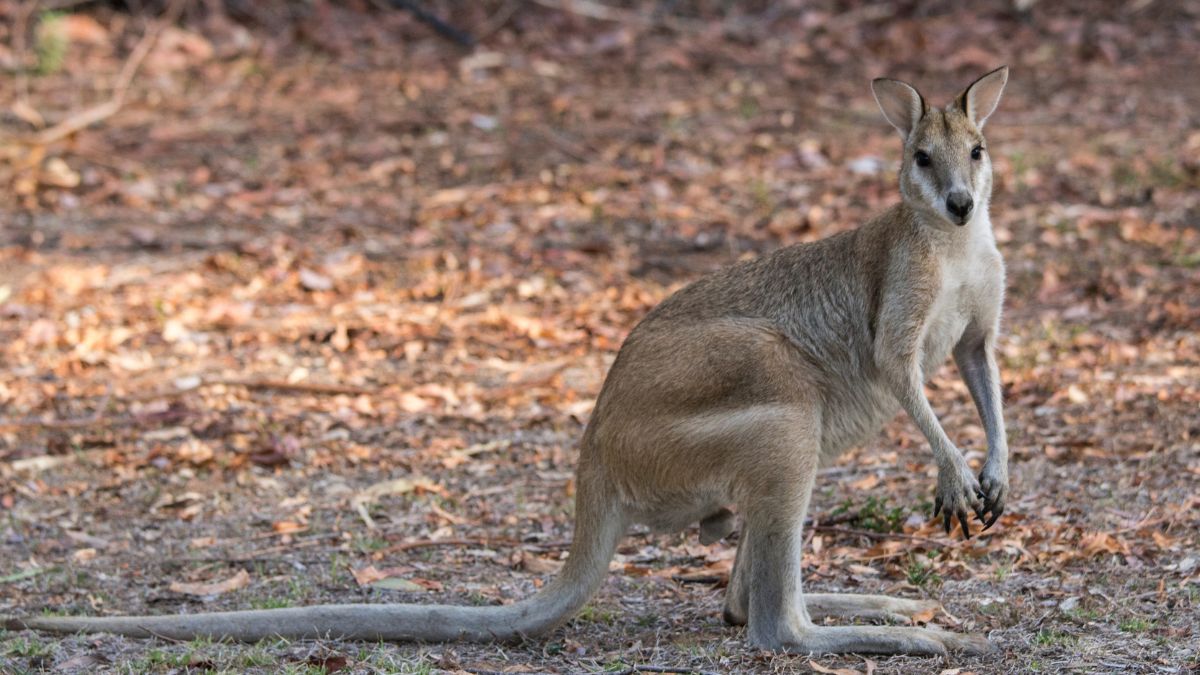
The Agile Wallaby (Notamacropus agilis) is a sandy brown macropod with a paler belly, black-tipped ears and a black tip on the tail. A pale stripe runs across each cheek and thigh, useful markers once you know to look for them.
Agile Wallabies in the Northern Territory show clear size differences between the sexes. Males can reach 85 centimetres in body length and weigh up to 27 kilograms, while females are noticeably smaller, usually under 15 kilograms.
How to identify them
- Sandy brown back, whitish underparts
- Large ears edged in black
- A black-tipped tail, long and flexible
- A pale cheek stripe and a pale streak across the thigh
- Males noticeably larger and bulkier than females
Agile Wallabies often move and feed in loose groups, which is a handy way to tell them apart from the more solitary wallaroos and larger kangaroos sometimes seen in the same country.
Groups mostly form around good feeding areas rather than being a fixed social structure, and members will drift apart and regroup as conditions change. Males will occasionally spar or “box” over access to females, standing upright and grappling with their forepaws in short, harmless-looking bursts.

Where to See Agile Wallabies in the Northern Territory Around Dundee Beach
Agile Wallabies in the Northern Territory favour open, grassy country close to cover, and the Dundee region has plenty of it.
Keep an eye out around:
- Roadsides and cleared verges around Dundee Beach
- Open woodland and savannah edges near Bynoe Harbour
- Grassy flats and paddocks in the wider Dundee region
- Bushland tracks early morning or late afternoon
Local Tip
Drive a little slower around dawn and dusk on bush roads. That’s peak feeding time, and wallabies crossing or grazing the verge are far easier to spot, and safer to avoid, at a lower speed.
The Best Time to See Agile Wallabies
Agile Wallabies in the Northern Territory are around year-round, but they’re most active and easiest to see in the cooler parts of the day. Early morning and the last light of afternoon are reliably the best windows.
During the heat of the day, they tend to rest in shade, so a slow walk along a bush track in the early morning is usually far more productive than a midday search.

Built for the Open Country
Agile Wallabies are true opportunists, adjusting their diet and range with the seasons. In the Wet Season they stick to smaller territories with abundant fresh grass, while in the Dry Season they range further afield as feed quality drops.
When startled, they rely on speed and quick, zig-zagging bounds to lose a predator, and it’s genuinely impressive how fast a group can disappear into cover once they decide you’re too close.
What Do Agile Wallabies Eat?
Mostly plant material, shifting with the seasons:
- Native grasses, their main food source
- Shrubs, leaves and fruit during the Wet Season
- Flowers, twigs, roots and bark as feed quality drops in the Dry
- Fallen leaves and browse from low vegetation
That flexible diet is a big part of why they cope so well with the Top End’s dramatic swings between Wet and Dry Season conditions.
More Than Just a Common Sight
Agile Wallabies in the Northern Territory play a genuine role in shaping the grassy understorey of the woodlands around Dundee, grazing in a way that helps keep fuel loads and vegetation structure in balance. As prey for pythons, dingoes and birds of prey, they’re also an important link in the local food chain.
Seeing wallabies grazing calmly at dusk is one of the small daily signs that the bush around Dundee is doing what it should.

Respect Our Wildlife
A few habits keep wallaby encounters good for everyone:
- Slow down on bush roads at dawn and dusk, when wallabies are most active
- Never feed wallabies, even if they seem used to people
- Keep dogs on a lead or under close control near bushland
- Watch quietly from a distance rather than approaching a feeding group
Like all native wildlife, Agile Wallabies are protected, so enjoy them from where they’re comfortable grazing.
Frequently Asked Questions
Are there Agile Wallabies in the Northern Territory around Dundee Beach?
Yes, Agile Wallabies are one of the most common macropods around Dundee Beach, especially along roadsides and open woodland edges.
When is the best time to see Agile Wallabies?
Early morning and late afternoon are best, when wallabies are actively feeding rather than resting in shade.
What do Agile Wallabies eat?
Mostly native grasses, along with shrubs, leaves, fruit and bark depending on the season. You can read more about the species on Animal Diversity Web’s Agile Wallaby profile.
Are Agile Wallabies dangerous?
No, Agile Wallabies are shy and will bound away from people, though as with any wildlife it’s best to keep a respectful distance and never approach or corner one.
Explore More Dundee Beach Wildlife
If you love spotting native wildlife, keep an eye out for more articles in our Dundee Beach Wildlife Guide, covering the birds, reptiles, marine life and mammals that make this part of the Northern Territory so special.
Whether you’re settling in at your accommodation or out exploring the bush tracks around Dundee, Agile Wallabies in the Northern Territory are one of the easiest native mammals to add to your wildlife list.

